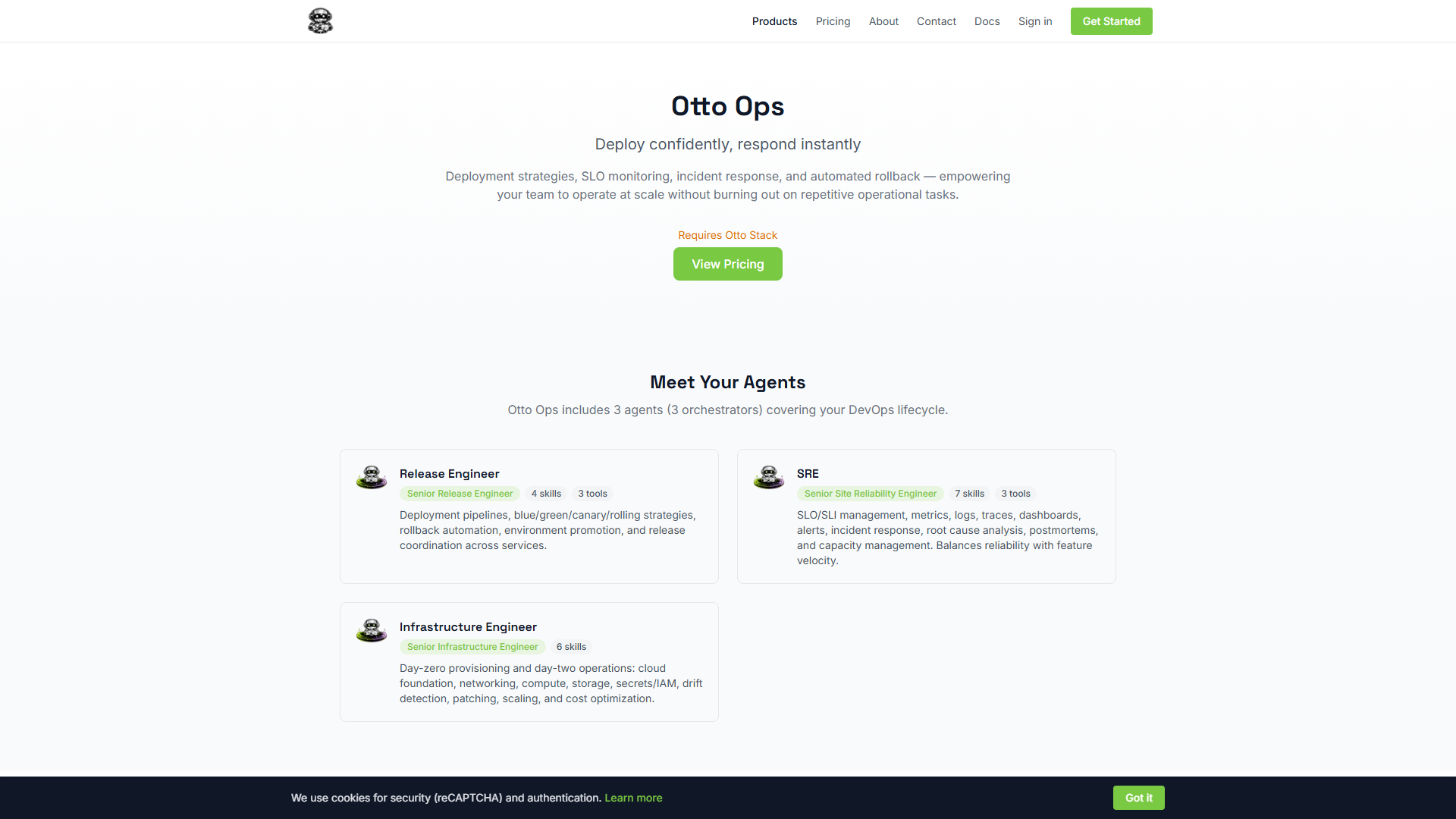
Otto Ops manages your deployment pipeline, monitors production systems, and responds to incidents. It supports blue-green, canary, and rolling deployments with automated rollback.
Capabilities
Deployment Management — Orchestrates deployments across environments (dev, staging, production) using your preferred strategy.
Deployment Strategies — Supports blue-green, canary, and rolling deployments. Otto selects the right strategy based on the change risk profile.
Automated Rollback — Monitors health metrics after deployment and automatically rolls back if issues are detected.
Production Monitoring — Tracks application health, performance metrics, and error rates. Alerts on anomalies.
Incident Response — When issues are detected, Otto generates runbooks, identifies the probable cause, and suggests remediation steps.
Environment Management — Manages configuration and secrets across environments with proper promotion workflows.
Deployment is executed using the configured strategy
Health checks verify the deployment is stable
If health checks fail, automatic rollback is triggered
Post-deployment metrics are collected and reported
DORA Metrics
Otto Ops tracks DORA metrics — deployment frequency, lead time for changes, change failure rate, and mean time to recovery (MTTR). These metrics help you understand your team's operational performance and identify improvement areas.
Infrastructure Support
Otto Ops supports three infrastructure tiers: Tier 1 (AWS, Azure, GCP) with full orchestration and IaC, Tier 2 (DigitalOcean, Vercel, Netlify, Railway, Render, Fly.io) with platform CLI deploys, and Tier 3 (VPS/on-prem) with SSH and Docker-based deployments.
How Otto Teaches
Otto Ops explains deployment decisions in context — why a canary deploy is safer for this change, what the error budget means for your SLO, and what DORA metrics reveal about your delivery performance. Your team builds operational confidence through every deployment cycle.
Agents
Otto Ops includes the following specialized agents:
Release Engineer — Deployment pipelines, blue/green/canary/rolling strategies, rollback automation, environment promotion, and release coordination across services.
SRE — SLO/SLI management, metrics, logs, traces, dashboards, alerts, incident response, root cause analysis, postmortems, and capacity management. Balances reliability with feature velocity.